Nel mezzo del camin di nostra vita
2025-12-06
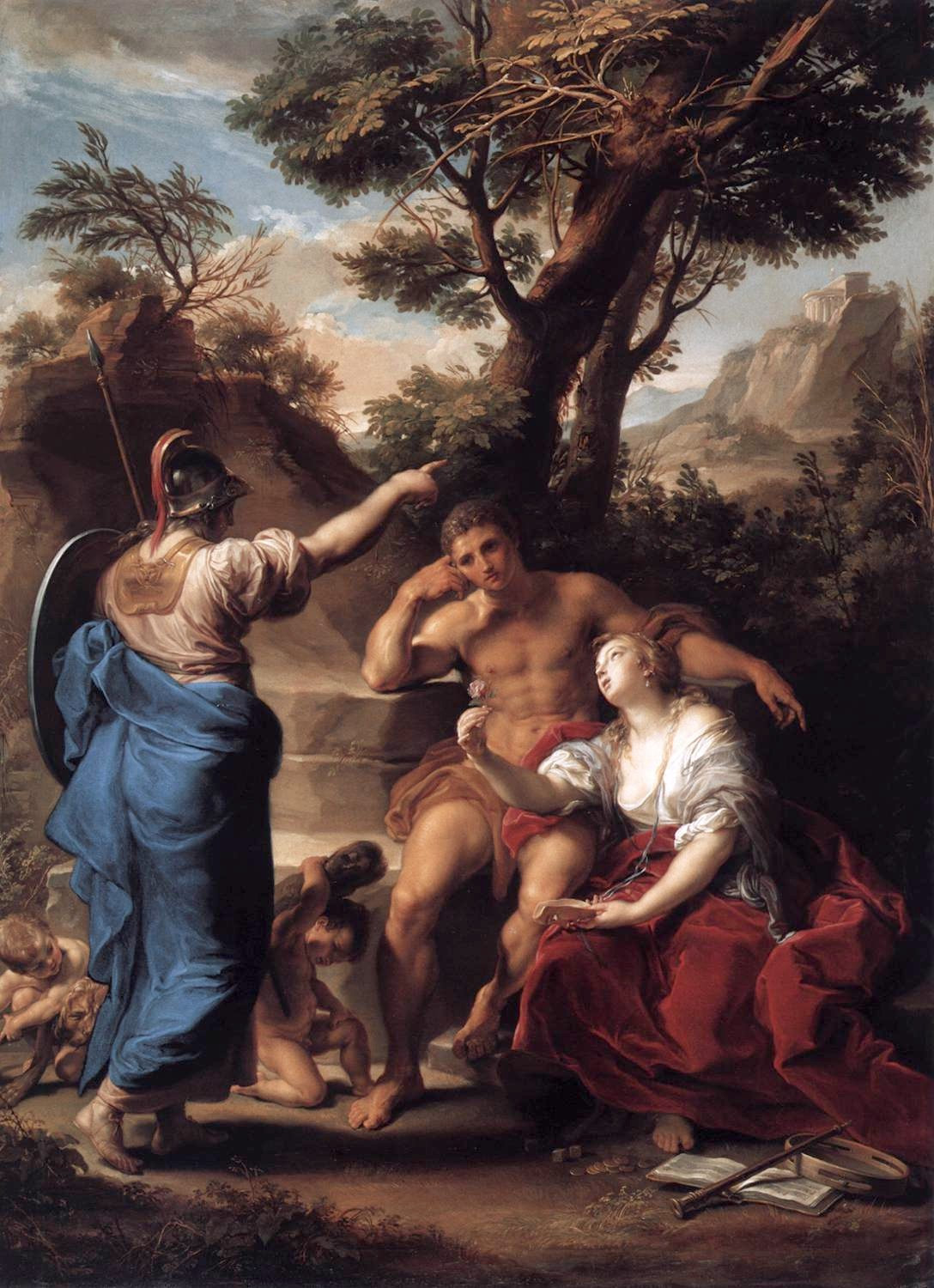
Since I'm now, according to the famous incipit, nel mezzo del cammin di nostra vita, I thought I'd write to my younger self, something I'd have liked a Virgil to have taught me as I struggled to find my way out of the selva oscura. At some point, a man finds himself like Xenophon's Heracles at the crossroads. This was early adolescence for me, a period I passionately hated. Somewhat less idealistically than the Herculean myth, I cannot say I made a choice, since it was long before I could articulate any of this to myself. The alternative was just so absolutely, viscerally repugnant, I just followed the dim light I could see in the dark.
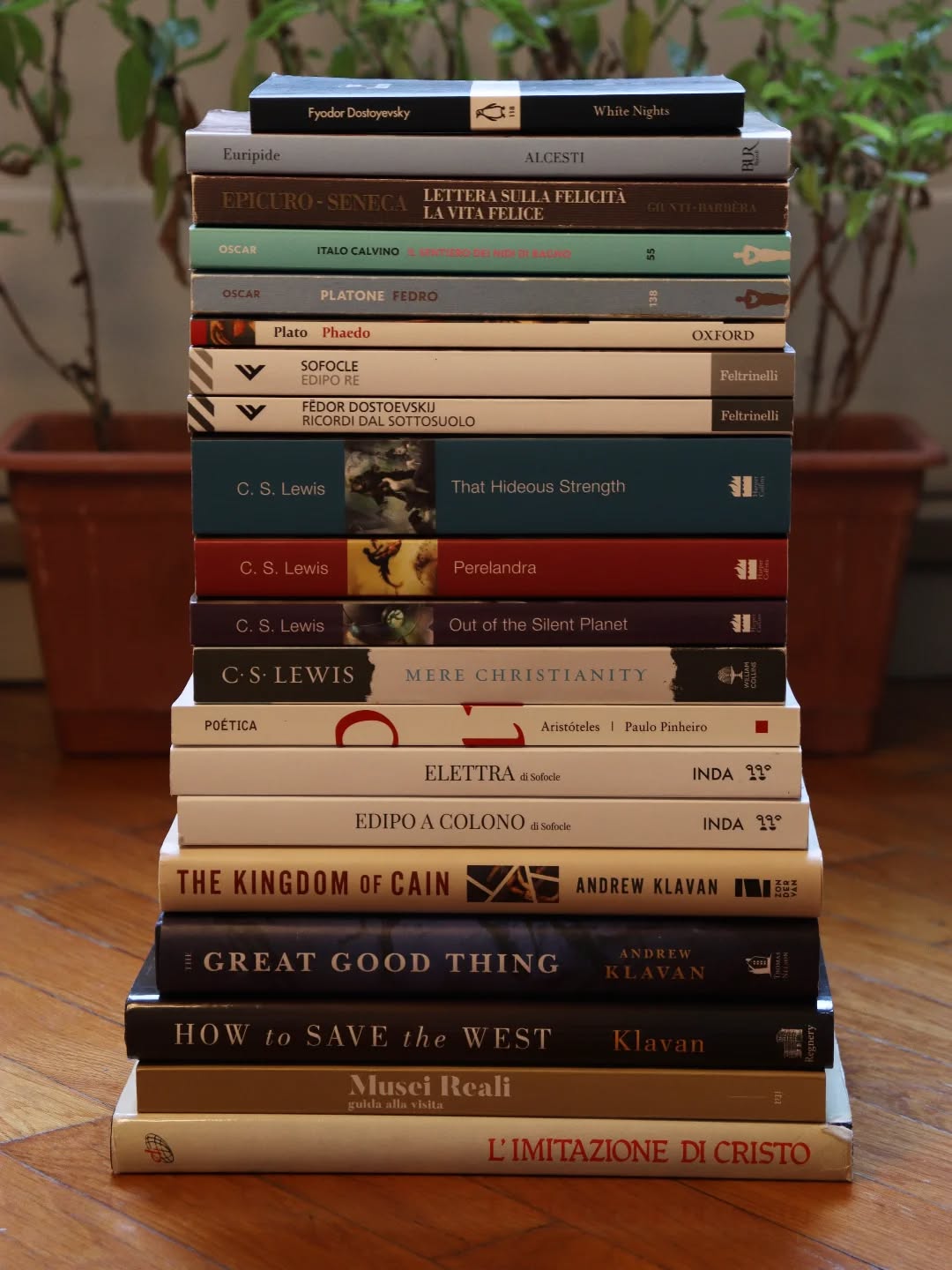
Above is what I've read in the last twelve months (24 books in total, but some are digital/not here, you can go to this page for the full list). The Greeks were correct: a mens sana is built through strife and education. Virtue/excellence is a habit, and happiness is virtuous activity. Aristotle engraved (the literal meaning of the word character, χαρακτήρ, from the verb χαράσσω) in the soul of man with these few words the principles of a happy life (εὐδαιμονία, not the fleeting feeling we now use that word for).
This is the straight and narrow path: cultivate your soul, turn it to ever greater things (semper sursum), to truth, goodness, beauty. This is the path to becoming yourself — not who you want to be, who you were meant to be. To be perfect (the same τέλειός of Aristotle, both of which mean “to be thoroughly made”, “to have fulfilled one's purpose”) as is the One in heaven. You'll be unstoppable. Your mind will seek the correct goals, and you'll have both the means and the discipline to achieve them. You will delight in it, seeing the struggle as pleasant. This, finally, is happiness.
Everything else is an illusion. Sound and fury, signifying nothing. Ignore it. Life is too short and precious and beautiful. It will not be easy. You should not pray for an easy life. You'll also be lonely, most of the time not even liked. You'll learn to let go of people, of those who do not have the same fire burning inside, who want to go on living like infants. It will hurt. But you'll get accustomed, and will begin to see it as a gift: for what is a man profited, if he shall gain the whole world, and lose his own soul?
Happy is the man who strives to be in life as he desires to be found in death, wrote Thomas à Kempis. And may I die (a prospect ever so near) echoing these two words of Heraclitus, the Obscure, who wrote so brilliantly precisely because he was the philosopher of tears:
ἐδιζησάμην ἐμεωυτόν
I have searched myself